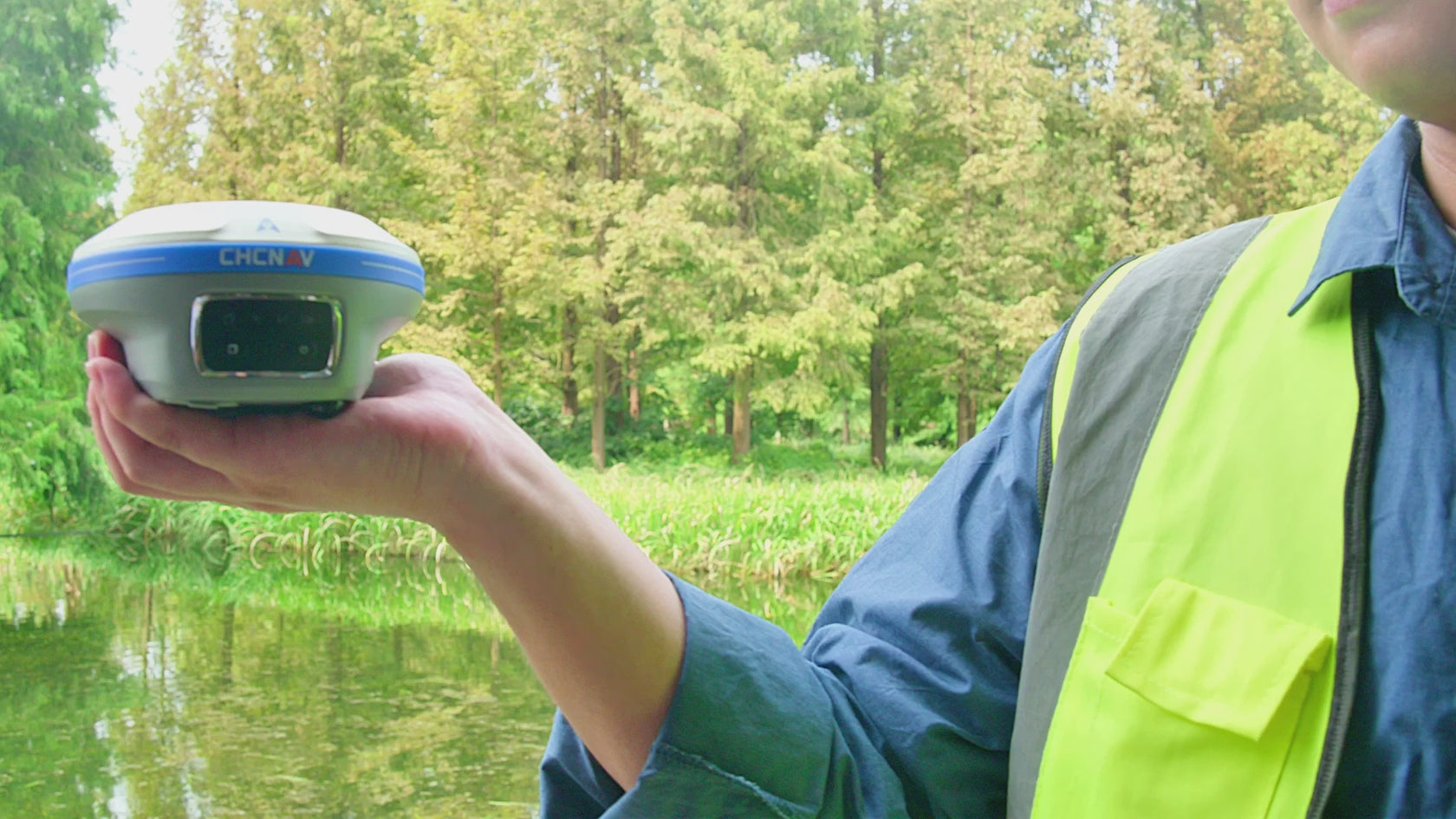


CHCNAV i89 Visual IMU-RTK GNSS Receiver
The i89 pairs a 1408-channel GNSS engine and AUTO-IMU with two global-shutter cameras. Record a short video and extract survey-grade 3D coordinates of points under eaves, behind fences or in traffic – no prism, no offset tape.
AR navigation and stakeout cut field time for new operators by up to 50%, and the 750 g receiver runs up to 16.5 hours.
Key features
- iStar 2.0 + ionosphere – 15% higher fix rates in harsh conditions and 20% better data quality via narrow-band multipath mitigation.
- Visual survey – Survey-grade 3D points from video; dynamic panoramic capture with 85% overlap is 60% faster.
- AR navigation & stakeout – VPT™ shows the point over the CAD design; linear, CAD and boundary stakeout.
- 3D modelling – Video photogrammetry of buildings and façades; fuse with drone data for large areas.
- AUTO-IMU – 200 Hz, no initialization, 3 cm across 60° tilt, up to 30% time saved.
- Fast charge – 16.5 h battery, 18 W quick charge to full in 3 h.
At a glance
- 1408 channels, iStar 2.0
- 96% fix rate, solar active
- 2–4 cm visual survey, 2–15 m
- 60° AUTO-IMU tilt, 3 cm
- 16.5 h rover; 18 W, 3 h charge
- 750 g IP68, 2 m pole drop
Order the i89 alone or as a visual survey kit with controller and LandStar. We train crews on visual survey and AR stakeout. Contact LATNET for pricing, kits and RTK network access.
Videos
See it in action
Short clips
- Authorized CHCNAV dealer in Canada
- Setup, training & local support from our Calgary geomatics team
- Shipped across Canada from Calgary
- See it before you buy – live demo or rental available
Technical Specifications & Features
CHCNAV i89 Pocket Sized Visual GNSS Receiver
CHCNAV i89 – survey what GNSS can’t see
The i89 pairs a 1408-channel GNSS engine and AUTO-IMU with two global-shutter cameras. Record a short video and extract survey-grade 3D coordinates of points under eaves, behind fences or in traffic – no prism, no offset tape.
AR navigation and stakeout cut field time for new operators by up to 50%, and the 750 g receiver runs up to 16.5 hours.

Six tools in one compact receiver
iStar 2.0 with ionospheric modelling keeps a fix rate above 96% when the sun is active. The AUTO-IMU needs no initialization. Dual cameras add visual survey, AR navigation and stakeout, and video photogrammetry builds 3D models of buildings and façades. All of it in 750 g.
Visual stakeout, laser survey and visual survey
CHCNAV’s visual IMU-RTK receivers add cameras, an IMU and – on the i85 – a green laser to centimetre RTK. You see design points in augmented reality on the controller, measure points you can’t stand on, and capture whole facades in seconds. Pick a mode to see how each one speeds up the job.
Visual stakeout (AR)
The receiver’s camera shows the site live on the controller with the design point, CAD lines and a guidance arrow drawn on the ground. Walk straight to the point instead of zig-zagging on ΔN / ΔE numbers – stakeout accuracy stays RTK-grade (8 mm + 1 ppm).
Laser survey
Tilt the pole, aim with the on-screen crosshair and fire the class 3R green laser. Building corners, points across a busy road or behind a fence are measured from where you stand – 3 cm within 5 m, 5 cm within 10 m.
Visual survey
Walk past a structure while the camera records an image group (typically 2 Hz). Back at the desk or in the field, pick points straight from the photos – typical 2–4 cm at 2–15 m range. Less time on site, and nothing gets missed.
How it speeds up the job
- Fewer steps per stake: the arrow and target ring on the live view replace the walk-check-correct routine of number-only stakeout.
- No levelling the bubble: the 200 Hz IMU compensates pole tilt up to 60°, so you measure as soon as the tip is on the point.
- No second instrument: laser and visual measurement cover corners, walls and hazards that used to need a total station or offset tape.
- Safer work: measure across roads, ditches and live equipment without stepping into them.
Illustration of LandStar workflows. Accuracy figures from CHCNAV datasheets; laser and visual results depend on range, lighting and target surface.
Why the i89 saves time
iStar 2.0 + ionosphere
15% higher fix rates in harsh conditions and 20% better data quality via narrow-band multipath mitigation.
Visual survey
Survey-grade 3D points from video; dynamic panoramic capture with 85% overlap is 60% faster.
AR navigation & stakeout
VPT™ shows the point over the CAD design; linear, CAD and boundary stakeout.
3D modelling
Video photogrammetry of buildings and façades; fuse with drone data for large areas.
AUTO-IMU
200 Hz, no initialization, 3 cm across 60° tilt, up to 30% time saved.
Fast charge
16.5 h battery, 18 W quick charge to full in 3 h.
Measure previously inaccessible points
Walk past the feature recording video; the i89 combines camera frames with IMU attitude and RTK positions, and LandStar lets you pick points on the images for survey-grade coordinates – typically 2–4 cm at 2–15 m.
Dynamic panoramic capture with 85% overlap improves efficiency by 60%, and point pickup success is up 15%.
- Global shutter 2 MP + 5 MP
- Typical 2–4 cm, range 2–15 m
- Up to 60 s capture, ~60 MB image group


Half the time for less experienced operators
Tightly integrated GNSS, IMU and cameras are ten times more reliable than gyroscope-based systems. The 1.5 GHz processor runs both cameras, adaptive 5.8 GHz Wi-Fi streams AR to the controller, and the virtual pole tip shows exactly where to put the pin.
From video to 3D model
Video photogrammetry builds 3D models of single buildings and façades from i89 data alone. For larger areas, fuse drone imagery with i89 RTK video to remove the distortion typical of drone-only models. Outputs work with industry-standard 3D modelling software.
3D modelling is activated with a function code.


Pocket-sized with a full-day battery
Optimised camera integration fits GNSS, IMU and two cameras into a 750 g body. The high-density battery runs up to 16.5 h as a rover (9.5 h with cameras) and 18 W quick charge fills it in 3 hours.
IP68 sealing and a 2 m pole-drop rating cover the rest.
- Φ133 × 87 mm, 750 g
- IP68, MIL-STD-810H vibration
- 16.5 h rover / 10 h UHF base


i89 vs i93 vs i85
All three use dual cameras with LandStar AR stakeout. Here is how they differ.
Where the i89 works best

Topographic survey
Fill gaps under eaves and canopy with visual survey.

Construction stakeout
AR guidance cuts stakeout time for any crew.

Building and façade survey
Pick corners and features from video.
3D modelling
Build models from i89 video or drone + RTK.
CHCNAV i89 technical specifications
| Channels | 1408 with iStar 2.0 |
|---|---|
| GPS | L1C/A, L2C, L2P(Y), L5 |
| GLONASS | L1, L2, L3* |
| Galileo | E1, E5a, E5b, E6* |
| BeiDou | B1I, B2I, B3I, B1C, B2a, B2b* |
| QZSS | L1C/A, L1C, L2C, L5 |
| NavIC / IRNSS | L5 |
| SBAS | L1, L5* |
| PPP | B2b-PPP, E6B-HAS (H 10 cm · V 20 cm) |
| Positioning rate | 1, 5 and 10 Hz |
| Time to first fix | Cold <45 s · hot <10 s · re-acquisition <1 s |
| RTK | H: 8 mm + 1 ppm RMS · V: 15 mm + 1 ppm RMS Initialization <10 s, reliability >99.9% |
|---|---|
| PPK | H: 3 mm + 1 ppm RMS · V: 5 mm + 1 ppm RMS |
| High-precision static | H: 2.5 mm + 0.1 ppm RMS · V: 3.5 mm + 0.4 ppm RMS |
| Static and rapid static | H: 2.5 mm + 0.5 ppm RMS · V: 5 mm + 0.5 ppm RMS |
| Code differential | H: 0.4 m RMS · V: 0.8 m RMS |
| Autonomous | H: 1.5 m RMS · V: 2.5 m RMS |
| Visual stakeout | H: 8 mm + 1 ppm RMS · V: 15 mm + 1 ppm RMS |
| Visual survey | Typical 2–4 cm, range 2–15 m |
| IMU | 200 Hz AUTO-IMU |
| Tilt | 0–60°; typically <8 mm + 0.7 mm/° tilt to 30° |
| Cameras | Dual global shutter, 2 MP & 5 MP; 75° FOV; 25 fps |
|---|---|
| Image group capture | Video photogrammetry, typically 2 Hz (up to 25 Hz); max 60 s, ~60 MB |
| Software | LandStar visual navigation, visual stakeout, visual survey, 3D modelling (function code) |
| UHF radio | Internal Tx/Rx 410–470 MHz, 0.5 / 1 W; CHC, Transparent, TT450, Satel; typical 3 km, up to 8 km |
| Wi-Fi | 802.11 b/g/n/ac, 2.4 & 5.8 GHz, AP mode |
| Bluetooth | 4.2 |
| NFC | Tap-to-pair |
| Ports | 1 × USB-C; 1 × UHF antenna (TNC female) |
| Data formats | RTCM 2.x/3.x, CMR in/out; HCN, RINEX 2.11/3.02; NMEA 0183; NTRIP client and caster |
| Storage | 8 GB |
| Size | Φ133 × 87 mm (Φ5.24 × 3.43 in) |
|---|---|
| Weight | 750 g (1.65 lb) |
| Front panel | 4 LEDs, 2 buttons |
| Operating / storage | –40 °C to +65 °C / –40 °C to +85 °C |
| Protection | IP68 (IEC 60529), 2 m pole drop, MIL-STD-810H vibration, breathable membrane |
| Battery | Built-in 7.2 V / 4,900 mAh; typical 2.2 W; 18 W QC, full in 3 h |
| Operating time | UHF/4G rover w/o camera up to 16.5 h · visual stakeout/survey up to 9.5 h · UHF base up to 10 h |
i89 FAQ
How does visual survey work?
You record a short video while walking past the feature. The i89 tags each frame with RTK position and IMU attitude; in LandStar you pick the point on two or more images and the software computes its coordinates – typically 2–4 cm at 2–15 m.
Does the i89 have a 4G modem?
No. It uses the controller’s data connection for NTRIP corrections such as the LATNET RTK network. The i93 has 4G built in.
Is 3D modelling included?
3D modelling is enabled with a function code. Ask us about pricing when you order.
How long does it take to charge?
About 3 hours with an 18 W quick charger.
Get the i89 from LATNET
Order the i89 alone or as a visual survey kit with controller and LandStar. We train crews on visual survey and AR stakeout.
Request a quoteAll GNSS receiversi89 POCKET-SIZED VISUAL IMU-RTK GNSS
EXTREME GNSS PERFORMANCE
VISUAL POWER ON TOP